MNCLHD

MNCLHD

Thursday, December 20, 2018

Cancer Council NSW tips for a healthier Christmas

While many of us are happy to indulge over Christmas, the extra girth gained seems less appealing once the New Year rolls around.

Weight gain over the festive season is a major contributor to excess yearly weight gain, especially for people who are already carrying more weight than they would like.

But rather than fearing the fare on offer, a few simple considerations when preparing food for Christmas can keep it fun and fulfilling, and healthy too

The Cancer Council suggest these tips to help keep the extra kilos at bay which not only includes increasing fruit and vegetable but has cancer prevention benefits too.

                                                                Source: pixabay

Contemplating the last Christmas together

Most Australians are looking forward to Christmas, to catching up with family, sharing a meal and family memories, and then relaxing over summer. However, around 200,000 Australian families will be affected by death and dying this Christmas.Yet many of us are unable to talk about what is happening and may avoid the topic of dying, which can leave families feeling isolated and unsupported.
Read more here on CareSearch to discover suggestions that have been made to help people facing bereavement at Christmas.

                                                                                                   Source: Caresearch

Tuesday, December 18, 2018

Guidelines for Guidelines

The NHMRC (National Health and Medical Research Council) recently launched 'Guidelines for Guidelines, providing guideline developers with practical advice on how to meet the 2016 NHMRC Guideline Standards.

It is an online resource comprised of a collection of peer reviewed modules that form a handbook that covers every aspect of the planning, development, review, implementation and updating of guidelines.

Public feedback is encouraged at consultations.nhmrc.gov.au.

Read more about the Guidelines here.

                                                                                              image credit: NHMRC

Thursday, December 13, 2018

BHI Healthcare Quarterly

BHI (Bureau of Health Information) has released its latest Healthcare Quarterly report, for July to September 2018, featuring measures of activity and performance in public hospitals and ambulance services in NSW.

Presentations to emergency departments were down 3.2% on the same quarter in 2017 and overall, timeliness of care in NSW emergency departments improved when compared with the same period last year.

Read the full report here or watch the video from the BHI website:


Tuesday, December 11, 2018

Australia’s international health performance is in the spotlight


The Australian Institute of Health and Welfare (AIHW) has built a tool that can be used to compare Australian data on health and healthcare with comparable international data.

International health data comparisons 2018, gives a new way of comparing Australia’s performance on variety of health-related measures using the data from 36 Organisation for Economic Co-operation and Development (OECD) member countries.

The tool delivers users with interactive data visualisations to create a comparison of key health indicators including life expectancy, health risk influences and causes of death. It also gives an understanding of how Australia’s healthcare system lines up, including data on our pharmaceutical market, health insurance coverage, and elective surgery waiting times.

The data shows that Australia performs well across most of the indicators.

To read more and gain access to the new data tool go to the AIHW website.


Friday, December 07, 2018

Great books about living with mental illness

Books that contain characters we relate to can provide a way to transcribe the messiness in our minds and understand other people's emotions.

Mental illness can sometimes make it challenging to find the concentration required to read, but these nine books are worth the effort, as recommended by SANE Australia.

Check out the books here. 
                                                      Source: SANE Australia

Tuesday, December 04, 2018

Looking for research information on the treatment of chronic respiratory conditions in Australia? This report might help.


Utilising PBS and MBS data to report on the treatment and management of chronic respiratory conditions 2016–17.

The above report investigates the use of the Pharmaceuticals Benefits Scheme (PBS) and Medicare Benefits Schedule (MBS) claims data to respond to vital research questions for reporting on the treatment and management of chronic respiratory conditions in Australia. Including high level analysis on medications dispensed for the treatment and management of chronic respiratory conditions in 2016–17, as well as dispensing patterns.


To download the report and read more go to the AIHW website


Friday, November 30, 2018

AN ONGOING STRUGGLE: THE OBESITY DILEMMA

Australian waistlines are continuing to grow. According to the Australian Institute of Health and Welfare’s latest report on the subject, published in June 2018, almost two in three adults were overweight or obese in 2014-15.

Twenty-eight per cent were obese in 2014-15, an increase from 19% in 1995. And 26% of children and adolescents were overweight or obese in 2014-15.

Pharmacists and other health professionals are in an excellent position to help people who are overweight make some lifestyle improvements.

It’s now well known that loss of just five to 10% of body weight can have significant health benefits, including for the cardiovascular system, an impact on diabetes, kidney disease and knee problems related to weight.

Read the full report here at ajp.com.au


Tuesday, November 27, 2018

Vaccine-preventable diseases


A new update has been released today by the Australian Institute of Health and Welfare.

Globally, vaccination is a successful and cost-effective health intervention. Funding for vaccination against 17 diseases to eligible people has been provided by the Australian Government through the National Immunisation Program.

This release is a series of downloadable fact sheets providing information about these diseases and how they affect the Australian population. Information includes statistics on cases reported, patients hospitalised and morbidity.

Read the release on the AIHW website.


8 hours sleep per day : Do we really need it?


Most of us try to live by the rule of eight hours of work, eight hours of play, eight hours of sleep. Tradition has long told us we need to have eight hours of sleep per day. Some profess that they need more, while others say they can function fine on four or five.

Is the human brain wired to need eight hours, or is everyone different? The Conversation asked five experts if everyone needs eight hours of sleep per day.

5/5 Experts say NO

Read their detailed responses here.


World AIDS Day Australia 2018

It's World AIDS Day this Saturday 1 December. The aim is to raise awareness across the community about the continuing issues around HIV and AIDS. It is a day for people to show their support for people living with HIV and to remember people who have died.

The first World Aids Day was held in 1988 and is observed by millions of people around the world. It is estimated that about 27,600 people live with HIV.

Find out more here.


Friday, November 23, 2018

What is “toxic” about anger? | OUPblog

The Oxford Word of the Year is a word or expression chosen to reflect the passing year in language. Every year, the Oxford Dictionaries team debates over a selection of candidates for Word of the Year, choosing the one that best captures the ethos, mood, or preoccupations of that particular year. The 2018 Oxford Word of the Year is: toxic.

It is the sheer scope of the word’s application that has made toxic the stand-out choice for the Oxford Word of the Year. Here, psychology professor Ephrem Fernandez reflects on what makes anger a toxic emotion.

                                                                       source: OUPBlog

Tuesday, November 20, 2018

Aboriginal and Torres Strait Islander Stolen Generations aged 50 and over

This report provides estimated numbers and demographic characteristics of the Stolen Generations survivors aged 50 and over in 2014–15. It presents data on a range of health and socioeconomic outcomes, and analysis of differences with an Aboriginal and Torres Strait Islander comparison group to examine the effects of removal from families. The findings will help to inform the needs for health, disability and housing services for the older Stolen Generations members.

Download the report here.

                                                                                                                      Source: AIHW

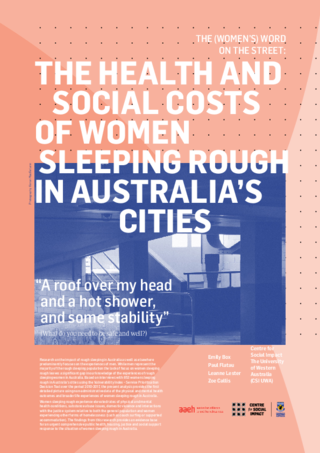
Women Sleeping Rough in Australia's Cities : What are the Health and Social Costs?


Researchers from the Centre for Social Impact at The University of Western Australia (CSI UWA) in conjunction with the Australian Alliance to End Homelessness (AAEH) have analysed the data of the health and social outcomes of women sleeping rough in Australia. The team brought together 853 interviews with women around Australia, using the Vulnerability Index – Service Prioritisation Decision Tool. This is a sample of over 8,000 interviews, collected in 2010-2017.

There is very little rough sleeping literature and what is out there has focused primarily on men. This is one of the largest studies of women sleeping rough in Australian cities. From this sample, we are seeing that women who sleep rough have poorer health and social outcomes, when compared to women who do not sleep rough, and different outcomes again to males in the same situation.

Download a copy here.

                                                                                                 Source: Analysis & Policy Observatory

Friday, November 16, 2018

Improving outcomes for patients, focusing on efficiency - All.Can Survey

Australians who have been diagnosed and treated for cancer have the opportunity to share their experiences with the world as part of a global research project launched by All.Can, an initiative committed to improving cancer care.

The All.Can initiative began in Australia in late 2017, and was officially launched on World Cancer Day (4 February) 2018. The patient-focused initiative aims to gather insights from the cancer community and sharpen the focus on delivery of care truly of value to patients.

Read more about All.Can in Australia here or click here to take the anonymous survey and share your experience.

                                                                       Source: All.Can